Article Three: The Missing Link Why Neuroscience Matters in Leadershipost
INSIDE-OUT LEADERSHIP SERIES
Exploring the connection between neuroscience, The Inner Self and the ripple we create through everyday leadership.
Article Three: The Missing Link
Why Neuroscience Matters in Leadership
Leadership has traditionally been understood through the lens of behaviour. Leadership development programs, professional learning, and management literature frequently focus on developing skills such as communication, decision-making, conflict resolution and influence. These capabilities are undoubtedly important, as they represent the visible aspects of leadership that others observe. Yet despite decades of research and an abundance of leadership models, many leaders continue to experience moments where their behaviour does not reflect their intentions. We have all experienced situations in which we later reflect and wonder why we reacted differently from how we had hoped. These moments suggest that effective leadership involves more than simply learning new strategies; they invite us to consider the processes that shape behaviour before it becomes visible.
In the first article of this series, I proposed that leadership begins within. Rather than viewing leadership as a collection of observable behaviours, I suggested that leadership is first an internal process. The second article extended this idea by introducing The Inner Self, a conceptual framework describing the unseen interaction between our thoughts, beliefs, emotions, values, identity, purpose, lived experiences and nervous system. Together, these internal processes influence how we interpret situations, regulate our emotions and ultimately respond to others.
This naturally raises an important question. If leadership begins within, what helps us understand the internal processes that shape our behaviour?
For me, the answer does not lie within a single discipline. Rather, it emerges through the integration of neuroscience, psychology, education and reflective practice. Each discipline offers valuable insights into human development and behaviour, yet none fully explains the complexity of leadership on its own. It is through their convergence that a more comprehensive understanding begins to emerge.
Looking Beyond Behaviour
Leadership is often evaluated through observable actions. We notice how leaders communicate, how they respond under pressure, how they build relationships and how they influence those around them. While these behaviours are important, they represent only the visible outcome of a much more complex internal process.
Advances in neuroscience have significantly expanded our understanding of how the brain and nervous system influence human behaviour. Rather than responding to events in a purely rational manner, the brain continuously interprets information from both the external environment and our internal experiences. Previous experiences, emotional memories, deeply held beliefs and physiological states all contribute to the meaning we assign to a particular situation. Consequently, behaviour is not simply a conscious decision; it is the culmination of numerous cognitive, emotional and physiological processes occurring beneath conscious awareness.
This perspective fundamentally changes the way leadership can be understood. Rather than asking how leaders should behave, it encourages us to ask what influences those behaviours in the first place.
An Integrated Perspective
Throughout my career, I have been fortunate to work across education, psychology and leadership while increasingly drawing upon developments in neuroscience. Initially, I regarded these fields as separate bodies of knowledge, each addressing different aspects of human behaviour. Over time, however, it became apparent that they were describing different dimensions of the same phenomenon.
Neuroscience explains how the brain and nervous system influence attention, emotion and decision-making. Psychology provides insight into motivation, beliefs, resilience, identity and wellbeing. Education demonstrates that leadership develops through relationships, learning, reflection and experience rather than information alone. Reflective practice enables individuals to intentionally examine their assumptions, behaviours and professional growth.
Viewed together, these disciplines offer a more holistic understanding of leadership than any one discipline can provide independently.
This realisation became the catalyst for developing The Inside-Out Leadership Framework.
The Inside-Out Leadership Framework
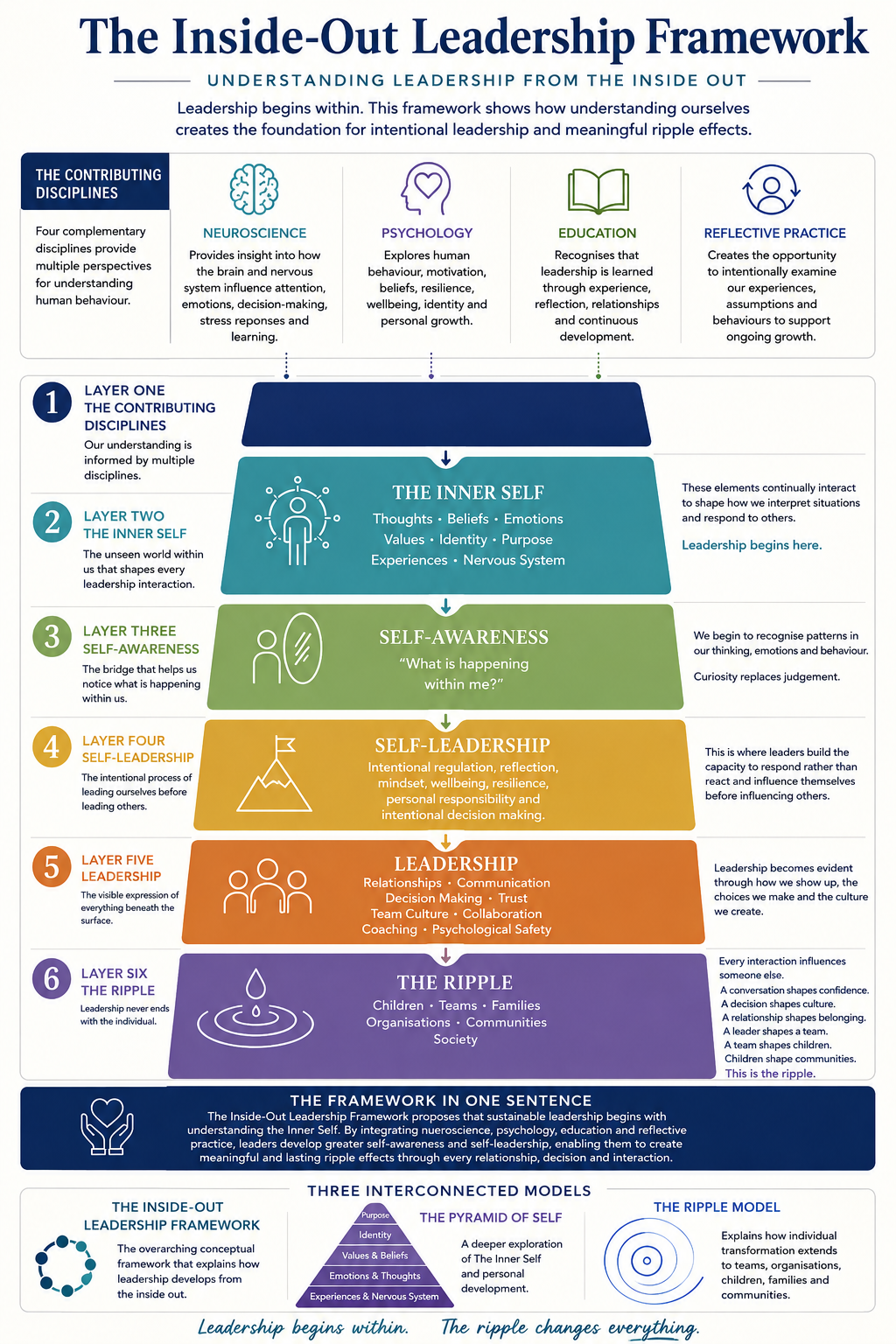
The Inside-Out Leadership Framework is not intended to replace existing leadership theories. Rather, it provides a conceptual framework that integrates insights from multiple disciplines to explain how leadership develops from the inside out.
The framework proposes that our understanding begins with four contributing disciplines: neuroscience, psychology, education and reflective practice. These disciplines provide complementary perspectives for understanding human development and behaviour. Collectively, they deepen our understanding of what I describe as The Inner Self.
At the centre of the framework sits The Inner Self, representing the dynamic interaction between our thoughts, beliefs, emotions, values, identity, purpose, lived experiences and nervous system. These elements continually influence one another, shaping the way we perceive situations, regulate emotions, make decisions and interact with others. Leadership, therefore, begins long before behaviour becomes visible.
From Understanding to Leadership
The framework proposes that understanding the Inner Self creates the conditions for self-awareness. Self-awareness, however, should not be viewed as the destination of leadership development. Instead, it functions as a bridge between understanding ourselves and intentionally leading ourselves.
Through self-awareness we begin recognising patterns in our thinking, emotions and behaviour. We become more curious about our reactions and more reflective in our responses. Rather than asking, "Why did I react like that?", we begin asking, "What was happening within me that influenced that response?" This subtle shift replaces judgement with curiosity and creates opportunities for growth.
Self-awareness alone, however, is insufficient. Awareness becomes meaningful only when it informs intentional action. This is the role of self-leadership. Self-leadership involves intentionally regulating our emotions, reflecting on our experiences, strengthening our wellbeing and making decisions that align with our values and purpose.
Leadership then becomes the visible expression of these internal processes. Communication, decision-making, relationships, trust and organisational culture emerge as outcomes of intentional self-leadership rather than isolated skills to be mastered.
The Ripple Beyond the Individual
One of the most significant implications of this framework is that leadership never ends with the individual. Every interaction creates consequences beyond the immediate moment. Conversations influence confidence. Decisions shape organisational culture. Relationships strengthen belonging. Leaders influence teams, teams influence organisations, and organisations influence communities.
For this reason, leadership should not be understood simply as an individual capability. It is a relational process that creates ripple effects extending well beyond the leader themselves.
Concluding Reflections
The Inside-Out Leadership Framework emerged from an attempt to integrate ideas rather than separate them. Neuroscience does not replace psychology, nor does psychology replace education. Instead, each discipline contributes to a more comprehensive understanding of human leadership.
At the point where these disciplines intersect sits The Inner Self.
Understanding this intersection changes the way we think about leadership. Rather than concentrating exclusively on behaviour, we begin to explore the systems that give rise to behaviour. Leadership becomes less about perfecting external techniques and more about understanding the person who is leading.
Perhaps this is the missing link in leadership development.
Leadership is not simply demonstrated through what we do.
It is shaped by who we are.
Continue the Inside-Out Leadership Series
The Inside-Out Leadership Series explores leadership as a process that begins within. Rather than focusing solely on leadership behaviours, the series draws together insights from neuroscience, psychology, education and reflective practice to explore how leaders think, feel, respond and grow. Together, these articles introduce The Inside-Out Leadership Framework, a conceptual framework that explains how greater understanding of ourselves leads to more intentional leadership and creates ripple effects that extend to teams, organisations, children, families and communities.
Article One
Leadership Begins Within
Why Great Leadership Is an Inside-Out Process
This article introduces the philosophy of Inside-Out Leadership, the belief that before we can intentionally lead others, we must first understand and intentionally lead ourselves.
Article Two
The Inner Self
The Part of Leadership We Never See
Before we can understand leadership, we must first understand ourselves. This article explores The Inner Self, the unseen interaction between our thoughts, beliefs, emotions, values, purpose, identity, lived experiences and nervous system, and examines how these internal processes quietly shape every leadership interaction.
Article Three
The Missing Link
Why Neuroscience Matters in Leadership
Discover how the brain and nervous system influence the way we think, feel and respond, and explore how neuroscience contributes to a deeper understanding of self-awareness, self-leadership and intentional leadership through The Inside-Out Leadership Framework.
Article Four
The Bridge
Why Self-Awareness Is Not the Destination
Self-awareness is often described as the foundation of leadership. This article introduces a different perspective, proposing that self-awareness is the bridge between understanding ourselves and intentionally leading ourselves.
Article Five
Leading the Leader Within
The Science of Self-Leadership
Explore how intentional self-leadership transforms our relationships, decision-making and everyday leadership practice, enabling us to respond with purpose rather than react out of habit.
Article Six
The Ripple
How Great Leadership Shapes Teams, Children and Communities
Leadership is never isolated. Every interaction creates a ripple that extends far beyond ourselves. This article explores how Inside-Out Leadership influences relationships, culture, wellbeing and lasting change through the everyday choices we make.
Article Seven
The Legacy
The Leader You Leave Behind
Every leader leaves more than results—they leave an imprint on the people they influence. This article explores how intentional leadership shapes cultures, develops future leaders and creates a legacy that extends well beyond our own time.
Continue the Conversation
Leadership is not a destination; it is a lifelong journey of learning, reflection and growth.
Which idea from this article resonated with you the most?
How has understanding yourself influenced the way you lead others?
Leadership begins within.
The ripple changes everything.
The legacy lives on.
Inside-Out Leadership is the original leadership framework developed by Lynne Kendall. This article forms part of the Inside-Out Leadership Series, exploring how neuroscience, psychology, education and reflective practice deepen our understanding of self-awareness, self-leadership and the ripple effects of intentional leadership
